In 1896, the resurgence of Irish Franciscan life and activity began in Friary of Multyfarnham. On Saturday December 11 of that year, a group of friars from St. Isidore’s College in Rome arrived at the Friary. They were specially delegated to the task of re-establishing Franciscan life in Ireland in the manner in which it had flourished before years of oppression forced it to alter its outward observances.
The group included Fr. Peter Begley OFM, Superior, who had arrived in Ireland the previous June, Fr. Nicholas Dillon OFM, Fr. Patrick Cahill OFM, Fr. Laurence O’Neill OFM, and Brothers Felix Steppler and Didacus MacNamara. Their arrival marked the complete shaking off by the Franciscan Province of Ireland of the restraints imposed by rigorous repressive measures of the past.
It proved a real turning point in the history of the Province, which witnessed a revival and an expansion of Irish Franciscan activity. The movement, initiated in Ireland at the Friary of Multyfarnham, achieved a degree of success hardly dreamed of by those responsible for its tentative beginnings.
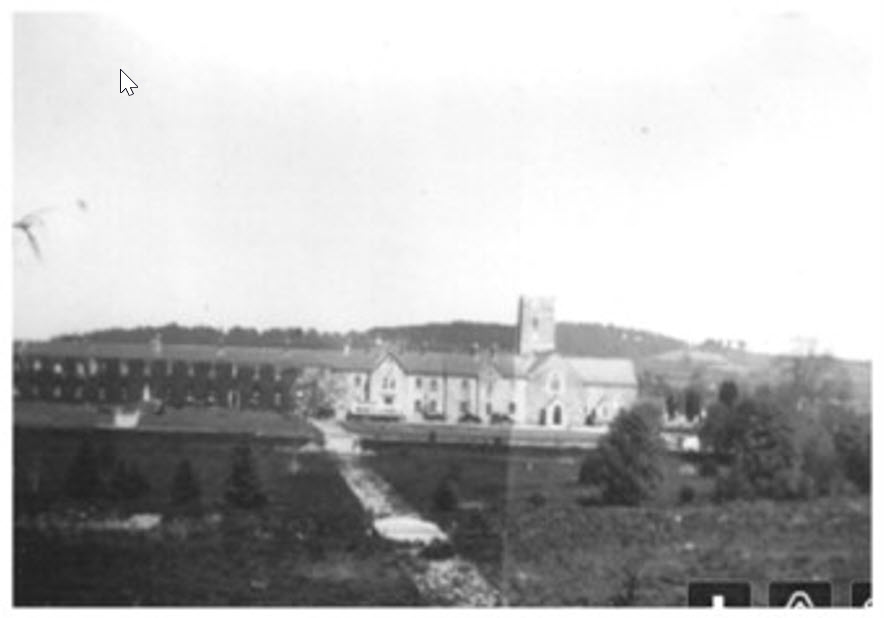
In 1897, Fr. Peter Begley OFM, laid the foundation stone of the Franciscan College in Multyfarnham. The primary purpose of the college was to foster vocations to the Franciscan Order. The west wing, a plain two-storey structure, was opened in October 1899. Two years later the north wing was added to meet the needs of the Province, and to cater for the increasing number of applicants, In 1914-1915 the east wing was built and the south wing completed the quadrangle of the buildings in 1932.
The number seeking admission to the college increased steadily from that autumn day in 1899 when it opened its doors to four boys. During its years of existence, the college played a major part in the development of the Franciscan Province. It supplied most young men who, solemn profession helped to build up anew the Franciscan Province of Ireland. In terms of foreign mission, it helped to establish Franciscan life on a firm foundation in Australia and in 1935 former pupils of the college founded a mission in China.
This missionary enterprise in China flourished until the advance of Communist forces compelled the friars to leave their mission posts. Before the closing of the mission in China, past pupils of the college embarked on mission work in Africa. Former students of Multyfarnham were among the friars who staffed and directed the Regional Seminary in Pretoria to train candidates for the priesthood in the diocesan missions of South Africa.
Besides extending the college as needs demanded, successive Guardians did much to preserve the church and to beautify the surrounding grounds. In 1908-1909, Fr. Stanislaus Ryan OFM, had the church thoroughly renovated. He raised slightly the walls of the old edifice, adding a new apse, and through the generous offers of four benefactors, had four marble alters installed.
At this time, the mortar was stripped from the time-hallowed walls of the church, thus laying bare, in austere simplicity, the ancient masonry, as it left the hands of the craftsman hundreds of years ago. It is of interest to recall that the Most Rev. Dr. Gaffney, retired Bishop of Meath, was, in accordance with his own expressed desire, laid to rest in the Friary church on Friday, December 17 1909.
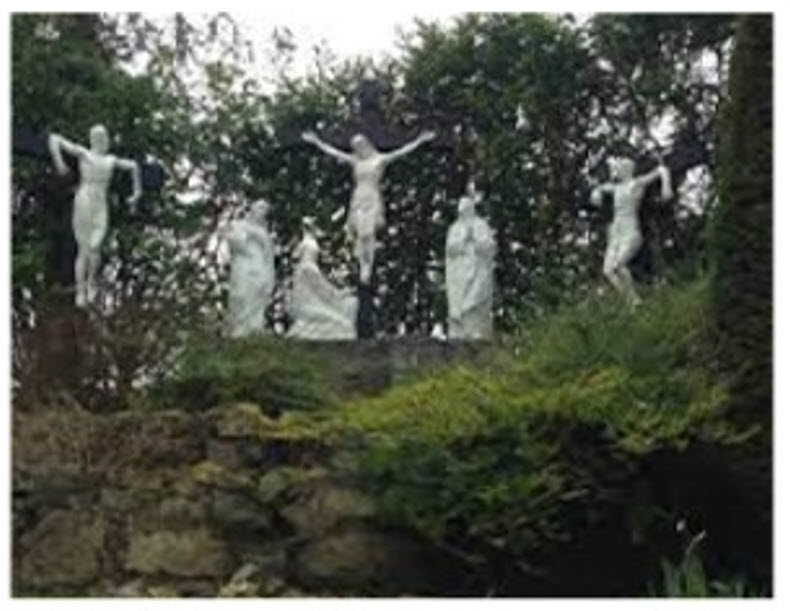
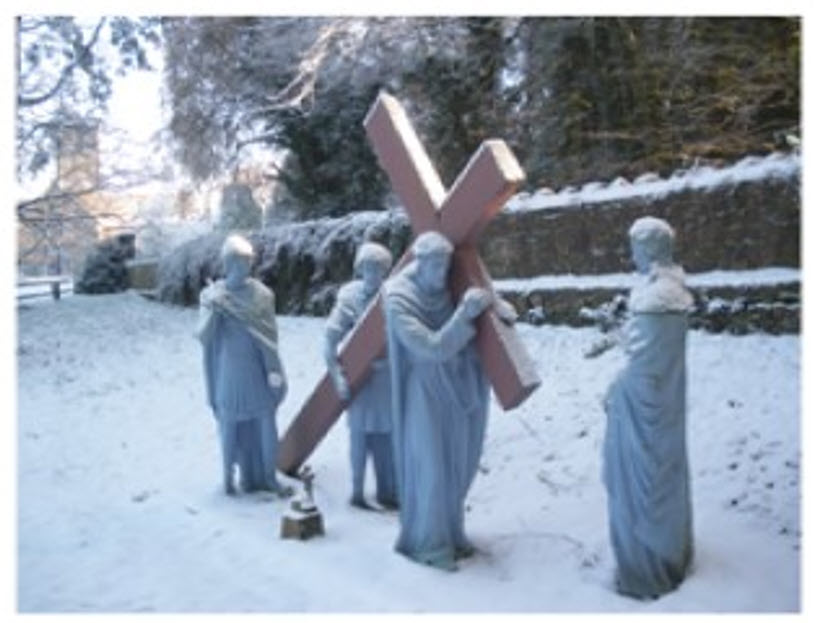
The grounds about the church and college were extended and beautified. In December 1938, a decision was taken by the friars to construct an outdoor “Way of the Cross” with life size statues; a unique phenomenon in Ireland and rarely found in other lands. The planning was carried out by Fr. Camillus Courtney the guardian of the friary. The figures were designed and supplied by Neff Brothers of Cork City. Mr. Denis Nolan was the engineer and a Mr. Hutchinson was the landscape Gardner.
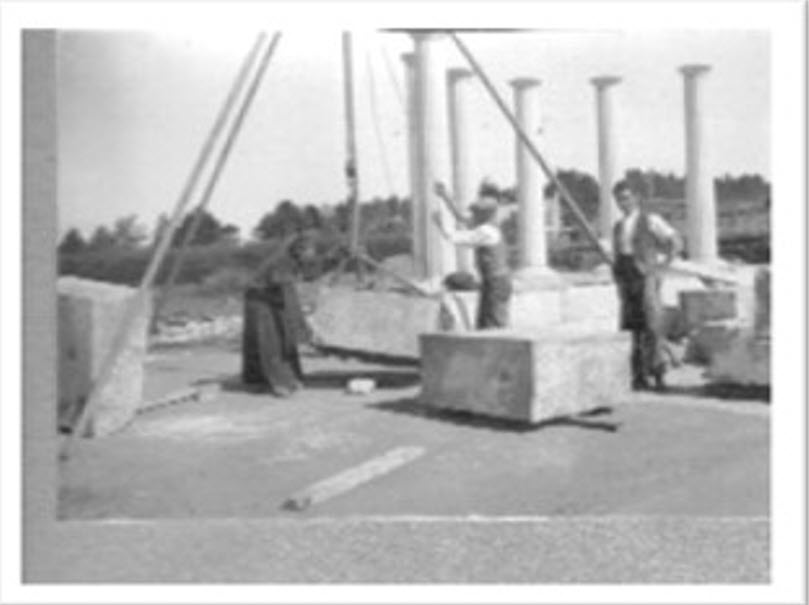
The “Way of the Cross” spanned both sides of the river Gaine which flows through the friary grounds. In 1939, copious quantities of cut stones were obtained by the friars from the demolition of two large houses in the district. These stones and pillars were used in the construction of the “Way of the Cross.” Two bridges were also placed across the river Gaine to allow for a two-way traffic system. The work was completed in 1942.
Pictured (right) are some of the pillars and cut stones used in constructing the “Way of the Cross.” These stones and pillars were used in the construction of the “Way of the Cross.” Two bridges were also placed across the Rver Gaine to allow for a two-way traffic system. The work was completed in 1942.
Prior to the construction of the “Way of the Cross” and the landscaping of this area it was a pretty barren piece of ground fronting on to the friary and church.
In 1943 a stone embankment was erected along each bank of the river Gaine. To accommodate the construction, the first and second stations of the cross were re-located to their present position. This work was commenced on the May 14 1943 and completed in October of the same year. The cut stones used in the construction were taken from the demolished outhouses of Ballincaloone House.
Those involved in the work were Nicholas Killian a stonemason from Rathganny, Multyfarnham, Matt Heavy, and Brother Francis Hession of the friary community. In 1949 Harrison Monumental Sculptors, Pearse Street, Dublin provided designs for proposed plaques to be placed in front of each station to commemorate their donors.
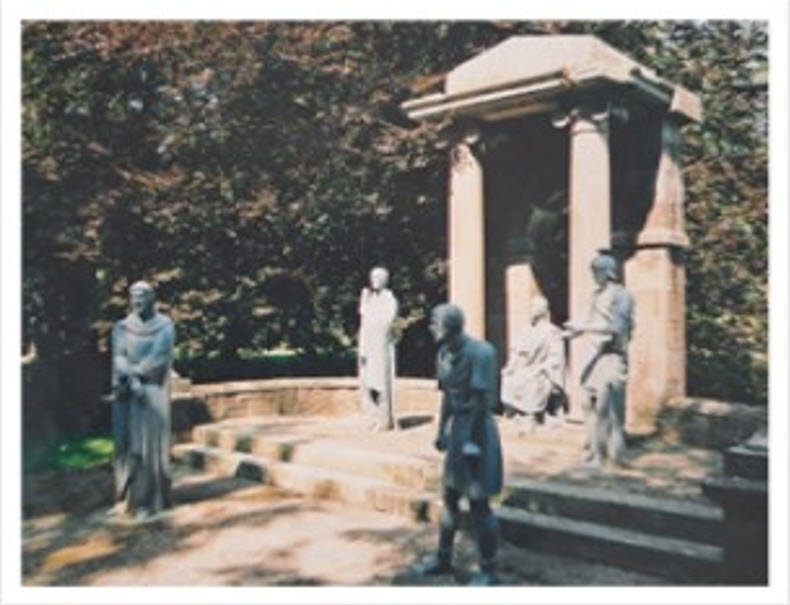
In May 1952 work commenced on the twelfth station to improve and elevate the site correctly. This involved the removal of up to twelve hundred tonnes of soil from a site near the farmyard. This was transported to the friary to re-construct the station. This work was completed in June 1952.
During the guardianship of Fr. Liam McCarthy (2015 to 2017) restoration work was conducted to clean and re-paint the statues of each station. Today’s visitors to the “Way of the Cross” can avail of the spiritual atmosphere and a place for reflection.