
The reading of the Passion of Our Lord according to John can be understood as a straight-forward historical account of the execution of a troublemaker in Jerusalem some two thousand years ago. But it can also be taken as a lengthy parable with a strong moral and spiritual message, conveyed especially by means of dramatic irony, for which the evangelist is rightly famous.
As I understand it, irony works in both language and action as having a double meaning, one being factual and the other symbolic. And it is the symbolic meaning or meanings (for symbols rarely can be limited to one application) that lead us deeper and deeper into the realm of divine and human mystery.
But enough of the abstract discussion, let’s look at the Gospel text for practical examples of shocking contrasts which highlight the topsy-turvy world into which the Son of God landed with his mission of salvation.
When Jesus is captured in the garden, we are informed that he is led first to the house of the retired high priest, Annas. Then, in an aside, there is mention of the actual high priest, Caiaphas, notorious for his condemnation of Jesus in the leader’s council or Sanhedrin.
That judgment contained words of high dramatic irony: “Surely it is better that one man die for the people than the whole nation should perish?” The irony lies in the double meaning. What the priest has in mind, his intention in speaking, is that Jesus is attracting many people to his cause.
They see him as the Messiah, the Son of David, the expected king who will establish a religious dynasty, based on God’s law. His entry into Jerusalem on Palm Sunday underlined the danger he presents, as the Roman authorities are always on guard against rebellion and have acted violently in the past to quell disturbances, especially at festival times when religious and nationalistic feelings are running high.
Here lies the irony of the words then: Caiphas presents himself as the saviour of the people, rescuing them from Jesus who is a threat to their already unstable existence under Roman rule. He is condemning to death the Son of God, the true saviour, not only of Israel but of the whole universe who is willingly going to the cross.
So, the false saviour murders the true saviour, thinking he is acting virtuously! And the evangelist explains the irony in terms of the deeper meaning of these words, now seen as implicitly prophetic, inspired by God. Without knowing it, and despite himself, Caiaphas becomes the instrument of God’s plan.
In God’s providence good comes from evil!
A second example is found in the judgment scene involving Pilate and Jesus. In the other gospels, Jesus says little at this stage and appears rather passive, but in John’s portrayal, the tables are turned on Pilate and it is the Roman governor who is being judged by his prisoner! Pilate represents the legal authority of Rome ruled by its august emperor, who dominates most of the known world of the time.
This petty bureaucrat judges, in the name of the emperor, an innocent man who is in fact the “King of Kings and Lord of Lords.” Pilate is meant to apply justice, that of Roman Law, to the Son of God who proclaims the supreme Law of God, “Love one another as I have loved you.” Pilate is meant to be operating from the point of view of truth, but he doesn’t appear to have any notion of what truth is, as he condemns the one is “the way, the truth and the life.”
To give Pilate his due he would like to release the accused and offers the crowd the choice between Jesus and Barabbas, a prisoner guilty of insurrection and murder. Surely the crowd will be moved to release the miracle worker and healer, but to no avail!
And here there is another example of irony, as the name “Barabbas” means in Hebrew “Son of the Father.” The writer of this Gospel wants us to recognise the madness of this situation where the true Son of the Father, Jesus, is to be murdered while the murderous son of the father is set free. Ironically, too, in this contrast we can claim that Jesus dies for Barabbas to reconcile him to the Father!
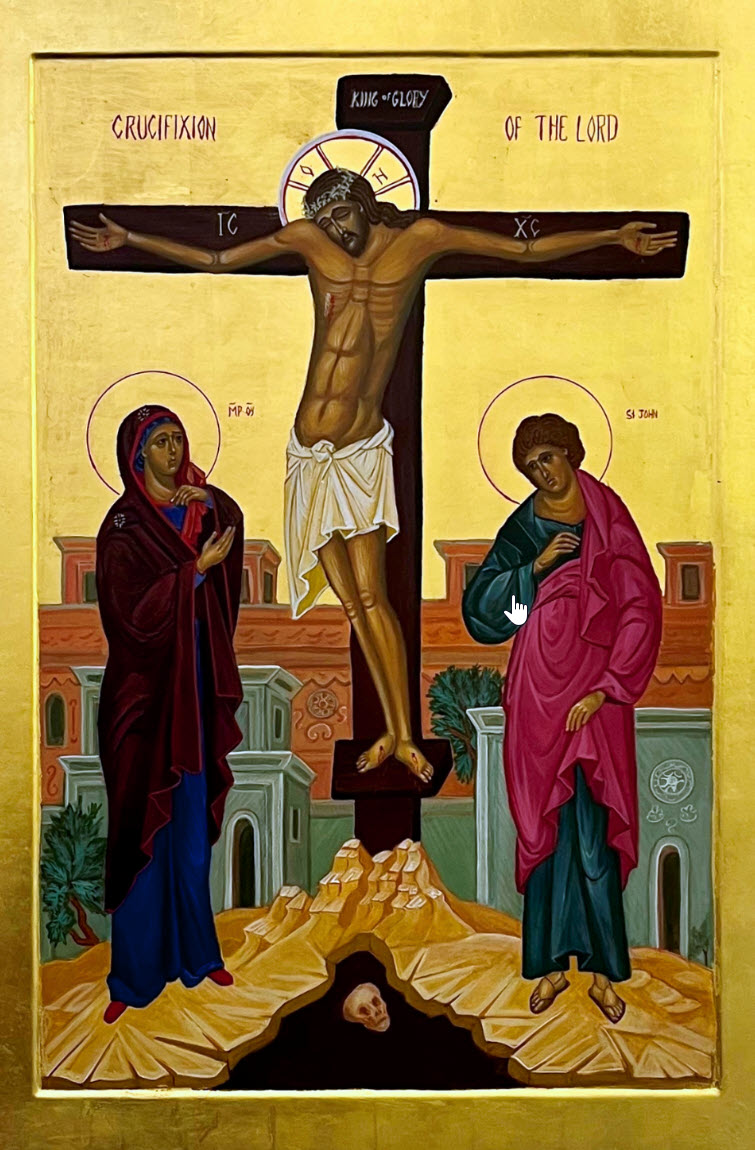
For me, the greatest irony of all in the passion story of St John occurs when Pilate himself follows in the footsteps of Caiaphas by fixing a notice on the cross announcing to all that this is “Jesus the Nazarene, the King of the Jews.” Obviously, Pilate intends this as a macabre form of humour, perhaps more sarcasm than irony?
It is not that the Governor wants to honour Jesus but rather to warn anyone who claims to be king in Israel in opposition to Caeser, that they will come to a similar fate. Yet again there is the deeper meaning, not grasped by this pragmatic politician who has no respect for truth. For Jesus tells him in no uncertain terms that “I am a King, I was born for this, to witness to the truth and all who are on the side of truth listen to my voice.”
The truth of Our Lord’s identity as King of the Universe is far from clear at this stage in the life of Jesus of Nazareth. But there is an even greater ignorance, amounting to betrayal, in the reply of the chief priests in response to the question of Pilate, “Do you want me to crucify your King?” Their answer is absolutely shocking coming from people meant to be in touch with the ultimate truth of the Jewish religious tradition. They cry out “We have no king but Caesar!”
But the basic belief of every Jew must be that God is their true King, the God who, unknown to them, is the Father of Jesus. This must be the lowest point in the passion narrative, where instead of witnessing to God to a pagan, they deny both God and the Son of God. In this there is the further irony that, at this point, the Jews actually insist on Pilate remembering that Jesus claims to be king and that “If you set him free you are no friend of Caesar’s, since anyone who makes himself king is defying Caesar.”
If irony implies a deeper meaning, not consciously intended by the speaker, then we could read this challenge as God speaking to Pilate and to all who are on the side of truth, saying: “you have a choice between being a friend of Caesar or a friend of Christ and the latter choice may involve you in defying the powers in this world that keep people from being free.”
This ironic journey with Jesus in his passion leads us to ask the same question as Pilate, (“what is truth?”) though in a more sincere, searching way as Christian faithful. The truth lies in the person of Jesus and his teaching.
Therefore, our first quest must be to situate the teaching of Jesus in the Gospels and of his followers in the rest of the New Testament in relation to our own world with all its turmoil and conflict. Of course, there remains a personal imperative to avoid lying to others and speaking the truth in personal relationships. But in addition to this traditional commandment, we need to reflect on how we communicate with each other in the internet age where “free speech” is vaunted so highly. In a world of “fake news,” “alternative facts,” social influencers and a plethora of attractive competing philosophies (ideologies) where is the truth to be found?
Are these voices in tune with the voice of Jesus who says, “Those who are on the side of truth listen to my voice”? His voice and his word must come first as a standard by which we judge all other inferior voices in every realm of life.
Specifically, in the Good Friday passion reading, the words and actions of Jesus speak to us and our world of the challenge to resist violence of all kinds, especially the violence of retaliation in the name of self-defence. Notice how Jesus refuses to defend himself though he has the power to do so. He calls on Peter to put down his sword and heals the ear of the man his apostle has assaulted. When slapped on the face for speaking truth to power in the encounter with the High Priest, Jesus defends himself verbally but doesn’t hit back.
No angel will save him from the cross. This is the ethos or moral character of the “Peaceable Kingdom” which Jesus came to inaugurate and which still has to come to fruition in a world of tit for tat violence, ranging from the war in Gaza, to people in arguments casting slurs back and forward with increasing venom, to economic tariffs, the main weapons it seems of the new kind of violence, “the trade war!”
King Jesus has revealed the truth to the world in word and action, in his public ministry and on the cross, but it can only be through the power of the Spirit given in the Resurrection of Jesus that grace will triumph over untruth and the violence it begets.
So, we live in Easter Hope in Jesus our brother and friend and in the Father who raised him from the dead. May these truths set us free.
Kieran ofm